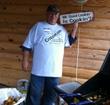
I'll bet they're glad I let them in on my little secret.

There is no doubt that spider rigging with live bait is the easist way to catch a crappie. There are many reasons why this is true and I'll list a few. First I'll just cover spider rigging, then spider rigging with jigs verses live bait, then cover minner critters, gnats, tippets and the spinners I make which are all successful for the same reason.
1. More baits in the water increases your odds to catch fish.
2. You only need to be in the approximate area of your structure due to being able to cover 30 or 40 feet with one pass.
3. If you don't have any idea where the fish are, you can cover more water in a shorter amount of time.
4. It's easier to figure out a pattern since you can set different poles at different depths until you get it right.
5. When you do hit a school of crappie, it is very easy to catch multiples before spooking them.
The above is just general information about spider rigging and why it is effective. Next, I'll cover why minner critters, gnats, grizzly jig tippets and my crappie spinners are effective. Most on here know that in the spring, I had trouble with good hook ups using road runner jigs while spider rigging. Because of this, I began to try to figure out why this was happening. In the process of this I built the crappie spinner and gave away a very large quantity of them. ALL that I got a report from gave the same report. They worked but the fish swallowed them too deep, which is not a bad thing if you're gonna clean the fish anyway and are not in a tournament. Here is my opinion why this happens...
The thump that you feel while jig fishing (which I will cover next) is not caused by the crappie sucking the jig in as we all have been led to believe, but it is caused by the lips of the crappie striking the vertical line down to the jig. A crappie is not going to just open his mouth wide enough for the bait to go in, but it will attack its prey with the mouth fully opened since the most of what a crappie eats is trying to escape and is not tethered by a line to be an easy target. This is the key to why everyone is not successful jig fishing. This is also the key to why a bite of a jig on the fall is hard to see. This is also the key to why my crappie spinners, meatgetters minner critters, donnies gnats, and grizzly jigs tippets work.
The crappie baits listed above have one thing in common. When they are fished properly, rather than the line hanging vertically down to the bait, the line leads to the bait horizontally. The bad side of this is YOU don't feel the thump of the lips striking the line unless the fish strikes perpendicular to the bait presentation. The good side is that the fish doesn't get a good view of the horizontal line when he strikes and the fish doesn't feel the line until the mouth is completely closed. This results in a better catch to strike ratio than fishing a straight jig or a minnow tipped jig. I will go a step furter and say that a non-bent shank on the hook will result in an even better hook up to strike ratio, but also may result in deep hook ups. Generally, when a person figures out the fish liked the bait faster while spider rigging jigs, it was not really because the fish were into "chasing" their prey on that particuar day since all animals are inherently lazy and like to expend the least amount of calories possible while obtaining their lunch. When you spider rig faster, you cause 2 things. The first being, you are fishing shallower and the second is, you are causing the jig to behave like my crappie spinner, a minner critter, donnies gnats or a grizzly jig tippet. Fishing faster causes the line to the jig to become more horizontal rather than vertical resulting in 2 things. The crappie cannot feel the line when it strikes, and the line is harder for the fish to see unless of course the fish are perpendicular to the line. All of the above mentioned baits have the following in common. An increased amount of drag in the water with a minimal increase in the weight. This causes the the fishing line, even at slow speeds, to assume a more horizontal position resulting in a fishing line harder for a crappie to feel and see.
Jig fishing and why people are "good" at it.
There are some people that have exceptional vision, reflexes, or a combination of the two. People who have these charcteristics are more likely to catch fish on a jig everyday. Even though there are days that everyone can jig fish, it is not the easiest thing to do consistently. First, you have the disadvantage of dealing with a vertical line which is easier for a fish to see and feel. When the thump is felt, you have a micro-second to get a good hookset because at that point, the lips of the fish have hit the vertical line, the jig is in the fishes mouth, but the mouth is still open, and he is in full "cancel this lunch order" mode. This is why the person with quicker reflexes has an advantage. This reflex can be honed by jig fishing more. When this reflex is coupled with great vision, so you are able to see the bite of the falling jig with the line horizontal (which results in a no thump condition), you have a great jig fisherman whether it is on his home water or anywhere else.
The thump vs jig weight.
I have found that the thump on a heavier jig is more pronounced than a thump on a light jig. This is not necessarily a good thing. As I have explained above, the thump is caused by crappie lips striking the vertical jig line. To the fishermen this means set the hook, to the crappie it means "get out of Dodge fast". Either the crappie or the fisherman win, depending on who is the fastest. To offset those days when your reflexes cannot match the reflexes of the fish, sometimes fisherman down size their baits. The result of downsizing causes you not to feel the "thump" as much, but neither can the fish feel the vertical line to the jig as much. A smaller weight in a jig also results in a slower fall time which causes the line to be in a more horizontal position in relation to the jig for a longer time. This results in the jig being deeper in the fish when you first feel him on. When the jig is deeper it is harder for the fish to release it before your hookset. Smaller jig, finesse fishing...I don't think so.
Yes, there are exceptions and variations to this, but think about the things above and see if it doesn't make sense the next time you are fishing.
Remember you saw this theory here first.
RCC

 Likes:
  Thanks:
  HaHa:
HaHa: 


 Reply With Quote
Originally Posted by MEATGETTER