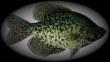
Junk Science Estimates for Ky Lake
Lets take a look at the survival rate for Young Of the Year crappie. These estimates may be Way Off! But lets say an average female crappie that spawns in the spring lays about 100,000 eggs and 1% of these survive. That would mean that 1000 YOY fish would be released into the lake. And lets say 10% of the YOY fish survive to 10 inches in size. That would mean about 100 mature 10" fish for every successful spawning pair of crappie.
If 1000 pairs of crappie went into the off limits section of Smith Bay and spawned, what would the result be from this. 1000 (spawning pairs)x 100,000 (eggs)x 1% (YOY survival rate) x 10% (survival rate of crappie to 10 inches)= 100,000 mature 10" crappie. Then lets also consider that this is something that would not cost the state nearly as much money as the state trying to stock 100,000 crappie into the lake.
Now this is may be junk science gone amuck. But if Smith and Duncan Bays had their Nov 1st - March 15 bay closures extended until May 1st, might it be possible to have as much as 100,000 - 500,000 mature crappie added to the lake each year? Note: (Duncan Bay's off limits area is much larger then Smith's) Would this added number of mature crappie make a significant difference in the fishing for the North section of Ky Lake? Also, no one is suggesting the major bays like Jonathan or Big Bear be closed during the spawn. Well over 90% of the lake would still be open for fishing if the proposed areas in Smith and Duncan were closed. In fact, 2/3s of Smith Bay would still be open to fishing.
Many have said rising and falling water levels during the spawn are the main factor in the Lakes crappie numbers. Well some things are out of our control. But water levels went up and down in the 50s, 60s, and 70s and Ky Lake had tremendous numbers of fish back then. What is the main difference between today and then? There are a lot of differences like the lake is much clearer these days, the black to white crappie ratio, but the main difference (in my opinion) is the amount of fishing pressure.
Give the fish a chance to spawn unmolested and we might be surprised by the results. And by the way, this experiment was done with a different species - the striped bass on the East Coast. Back in 85-89 a moratorium was placed on the Chesapeake Bay stripers. When the fishing was reopened in 1990, there were millions of striped bass from Maine to North Carolina. This was a great success story brought about by controlling the fishing pressure.
One last issue, for those who witness someone doing something illegal on the water. You should get the violators vehicle or boat number and report the violation to the KDF&W. I would not recommend confronting the violator, problems could ensue. But if you are not willing to report these violations you should not be complaining when something has not been done.
The heavens declare the glory of God and the skies proclaim the work of his hands. Psalm 19:1


 Likes:
  Thanks:
  HaHa:
HaHa: 


 Reply With Quote