
 Likes: 0
 Thanks: 0
 HaHa: 0

 Crappie.com Legend - 2022 Crappie.com Man of the Year

 ice flies and teardrop jigs
Creating a teardrop jig
--------------------------------------------------------------------------
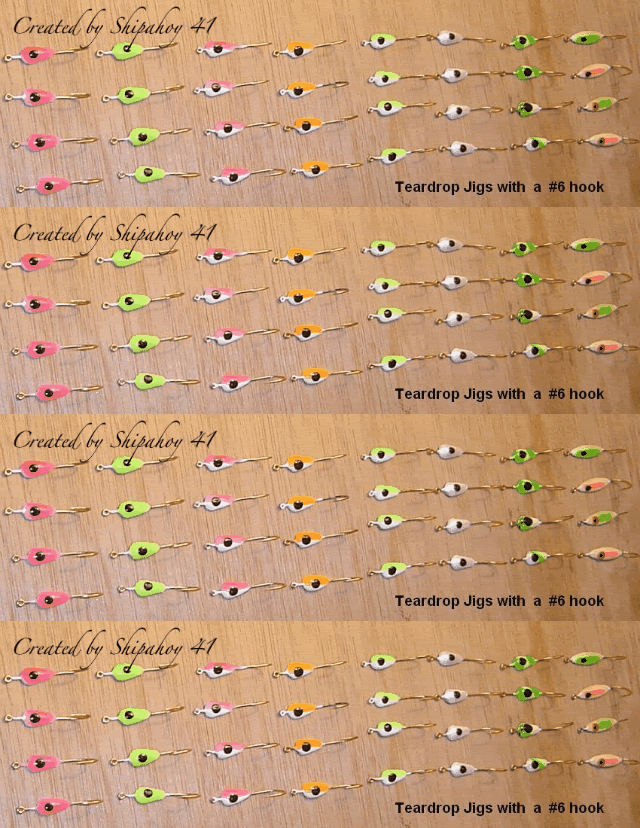
The best baits for teardrops are small perch minnows, wax worms and spikes. You can make your own teardrops. Here is how and also a few tips. Here's a tip to increase your catch - you should always bury the hook point in your bait. Having the bare hook point sticking out of your bait will turn off wary fish. Under certain conditions, other colors can work as well or even slightly better depending on the fish’s mood. People fish them year round under a slip bobber. The nickle finish acts like a flash under water. The small weight of the pinmin gives stability to the hook yet it is easy for the fish to inhale. You can get the shells at Jann's Netcraft. Solder the hook to the shell, paint, tip with a wax worm and fish on!
If you’re into a school of fish that suddenly stop biting, changing to a different color may turn them on again, so you should always have at least two or three other colors besides glow in the dark. A general rule for choosing the right color is - bright for bright days and dark for cloudy days or night fishing. Chartreuse and fluorescent orange are good choices as well as dark reds and any shade of green. The bread and butter lure for panfish is undoubtedly the teardrop. These inexpensive little jigs have been responsible for more limit catches than all the other lures combined. If you’re fishing for bluegill, crappie or perch you better carry a few teardrops. To get maximum action out of your teardrop, you must choose the correct line and use a loop knot for connecting your jigs. Bluegills, especially the large ones, are very line shy. Always use the smallest diameter line you can, no more than 2lb test. For more aggressive fish like crappie and perch you can use a heavier line such as 4lb test.
Vertical to Horizontal. The style of one's jig is just as important as its color. Most anglers are accustomed to using a tear-dropped shaped jig that hangs vertically in the water, such as Shipahoy 41's Teardrop jig. I have found that crappies and perch generally bite better on a horizontal jig.
How To Solder A Spoon And Pin Minnow
Getting ready
Once I get my tools rounded up I like to plug in my soldering iron and let it heat up while prepping my materials. First things first, the tip of the soldering gets hot - up to 800 degrees Fahrenheit, so don't touch it. If you're using a new soldering iron you will want to put a small amount of solder on the tip of the hot iron before you start working. This is called tinning the iron and you only have to do it with a new iron. Once you start using it will usually have some solder on it already and be ready to go.
HOW TO SOLDER
Soldering is defined as "the joining of metals by a fusion of alloys which have relatively low melting points". In other words, you use a metal that has a low melting point to adhere the surfaces to be soldered together. Soldering is more like gluing with molten metal than anything else. Soldering is also a must have skill for all sorts of electrical and electronics work. It is also a skill that must be taught correctly and developed with practice.
Ice blades are usually soldered to Mustad 3282 (nickel) and 3260B (gold) hooks. Bronze hooks will NOT solder unless you scrape the finish off.
Soldering is nearly instantaneous, if the solder doesn't flow around the work in 1/4 of a second then something is wrong and you need to start over again.
Don't let the joint move until it has cooled enough to set, it should look mirror shiny all around.
How To Solder
Step 1: Equipment
Soldering requires two main things: a soldering iron and solder. Soldering irons are the heat source used to melt solder. Irons of the 15W to 30W range are good for most electronics/printed circuit board work. Anything higher in wattage and you risk damaging either the component or the board. Note that you should not use so-called soldering guns. These are very high wattage and generate most of their heat by passing an electrical current through a wire. Because of this, the wire carries a stray voltage that could damage circuits and components. The choice of solder is also important. One of the things to remember is to never use acid core solder. Acid core solder will corrode component leads, board traces and form conductive paths between components. The best solder for electronics work is a thin rosin core solder. I prefer a thickness of 0.75mm, but other thicknesses will also work. Just remember not to get anything too thick.
Remember that when soldering, the rosin in the solder releases fumes. These fumes are harmful to your eyes and lungs. Therefore, always work in a well ventilated area. Hot solder is also dangerous. Be sure not to let is splash around because it will burn you almost instantly. Eye protection is also advised.
Aquatic Species Removal Engineer.
May God be with you. Keep CALM and STAY ANCHORED with your faith.
Posting Permissions





















 Reply With Quote